
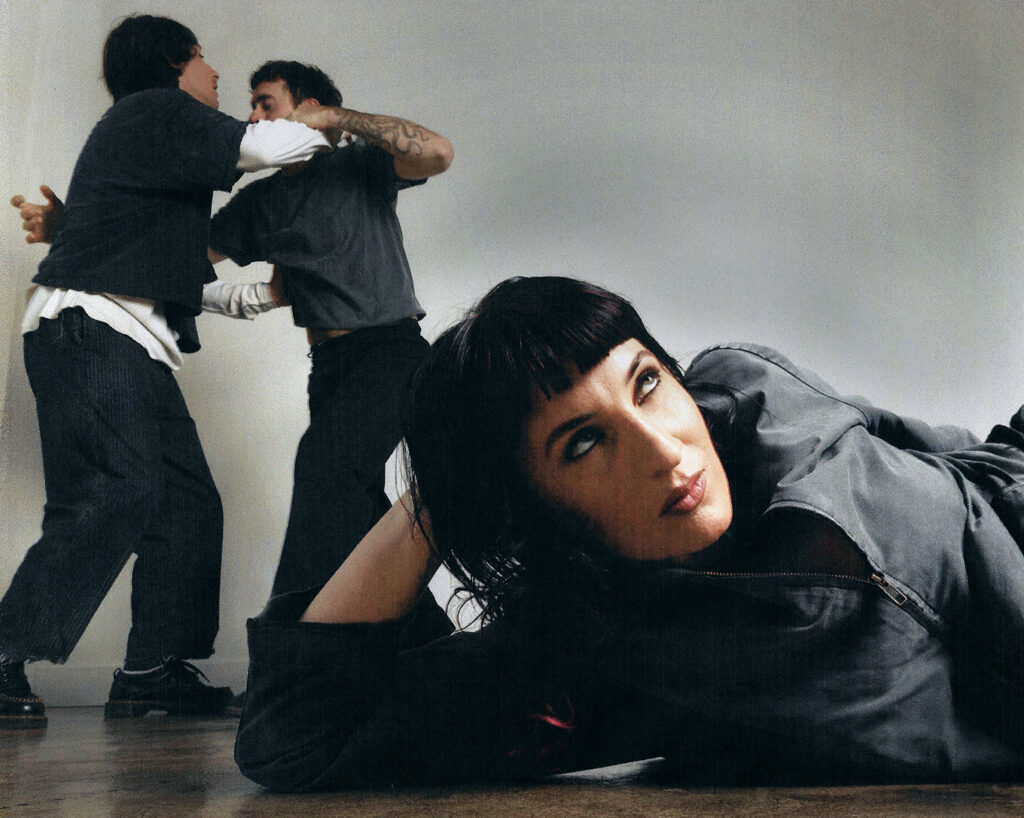
At first, EAVESDROPPING gives the impression of living through other people’s lives. The album by ill peach is a kaleidoscope of overheard conversations, stories that unfold without the listener’s participation. After the loss of her father in the midst of creating this album, frontwoman Jess Corrazza was eager to escape her reality. The core of the record is a desire to understand human experience and connect through familiar patterns, while at the same time allowing for a safe distance to process.
ill peach is a band composed of Jess Corrazza on vocals, Pat Morrissey on keys and Jesse Schuster on guitar. The trio met in high school in Minnesota and formed a friendship through their common passion for music. Although life took them in different directions, they orbited each other throughout college. After writing professionally for big artists in New York City, Corrazza and Morrissey started to work together. This caused the music industry to categorize their work as sitting outside the box, which prompted the formation of the band. With ill peach, they could express their creative vision.
The opening track “DINNER FOR ONE” encapsulates what EAVESDROPPING is all about. Beginning with chatter and zooming in on Corrazza’s soft voice, she seems to speak directly to the listener. The production takes on a grandiose approach, ending on an ominous touch that flows into “RODEO.” It is the last single off the album and summarizes the project through the metaphor of bull riding.
“Weaved together from so many conversations about the ups and downs of life, it became this symbol that life is like riding a bull. Uncontrollable. You fall, get back up, face plant in the mud and the muck, and maybe finally hold on for 8 seconds.”
Jess Corrazza
“MOLLY’S NOT A FRIEND” captivates with drums and electric guitar. It sets the scene by transporting us to the club where the story unfolds. Although it is an upbeat track, it hides a darker story. The track was inspired by the lead singer’s experience with taking MDMA while going through the grieving process and the negative reaction that ensued. “CRUMBS” follows this sinister throughline with a seductive, almost sickening, attachment to a person.
“ALL DAY I DREAM ABOUT SLEEP (A.D.I.D.A.S)” faces the truth head on. The exhaustion of life that turns into burnout is captured well within the lyrics, as well as with Corrazza’s vocal interpretation. Where this is about a waiter in the service industry, “CULT DADDY” is about a friend that realized they were in a cult. Through raw, visceral songwriting, they show their skill in translating stories to sound.
“SMALL TALK” follows the search for meaningful conversations. On a similar wavelength, “CRASH COURSE DUMMY” expresses the difficulty of fitting in. Although inspired by the loud person who tries too hard, Corrazza drew a parallel to her introverted self. She zoomed in on the feeling of drifting away from the crowd. The album ends with “ASHTRAY,” with lyrics that compare a relationship to a smoking addiction. It takes us through the dilemma that takes place within the mind of an addict, while Corrazza’s voice fades away. The track that closes the narrative of the record with a goodbye bow.
All Too Creative spoke to the band about their sophomore record EAVESDROPPING, out now.
ATC: What inspired you for the fly on the wall imagery for the album?
CORAZZA: I have a knack for eavesdropping, which I feel like another way of describing that is being a fly on the wall. When trying to figure out some imagery for the album, that seemed like the coolest thing that we came up with.
ATC: Could each member introduce themselves and say what each one of you brings to the creative process?
CORAZZA: I’m Jess. I’m the singer of ill peach. I’m probably the one that’s the most pain in the ass in the creative process. When I have a really strong vision or a way that I want something to sound sonically, I have to describe it so it can be created by Jesse and Pat. That’s very challenging, where it’s a lot of being like, “No… no… no, that’s not right.” I also think that I bring a lot of the concept, and I’m a very visual person so a lot of the storytelling as well.
MORRISSEY: I’m Pat. I am the producer, I play the keys, and I distract the band members as much as I can from getting anything done. This band is not really defined in any way besides Jess being the singer. The three of us collaborate equally and bring something different to the table each each day that we get in the studio. This time around, Jess had this clear concept for the album, which the last album didn’t have a through line. It wasn’t really a concept album. This album we had this anchor. You could tether everything to the storytelling, the lyrics, the tone, and sonically how things were going to be shaped.
Jesse, who isn’t with us today unfortunately, he is the guitar player mostly. He also produces and contributes with melodies and some lyric ideas as well. This process started with a lot of his ideas, then I got in there and started to shape how I think it should sound. Then Jess would come in there and ruin everything by telling us to change it all (Corazza laughs). That’s not true, but she definitely had the final say, and that’s how it’s always been. She has the clearest vision, and I think my brain is a little bit more ADHD. I get sounds and music, so I’m like, “Let’s have it all, let’s put everything in there.” She’s much more minimal with her taste.
ATC: It seems like you guys have a multi-disciplinary dynamic. Everyone contributes in different ways, not just one specific thing.
MORRISSEY: It started out as a studio project more than just a traditional band. When it when it starts in the practice room with the instruments, it’s a little bit more defined. We’re coming at it every day with whoever has an idea, let’s throw it up and then we all work from there.
ATC: Congrats on the album! You talked about how this album is about human interactions. How has observing other people influenced the storytelling of the record?
CORAZZA: I have to this day the worst habit of listening in on people. It’s interesting how sometimes you overhear the craziest story where they maybe shouldn’t be talking about this in public. A lot of human interaction and conversations, we fall into the same patterns. People are talking about the challenges of life. I think a lot of that storytelling was easy to pull from, but I had to exaggerate in some moments. I could walk away from a session of eavesdropping and be like, well, that’s a story about a breakup. If anything, it makes it show that we have this beautiful tapestry as humans, and we all experience the same things.
MORRISSEY: What I found that so interesting about it is Jess had the idea, and it didn’t start with overthinking. It was like, “Okay, here’s an interesting idea for an album. Let’s just commit to it and run with it, and see what happens.” It wasn’t until after we started making the songs that we started asking the questions of, “What does this mean and why do we do this as people? Why are we so interested in other people’s lives or stories, and not our own?” For me, that’s where it got really interesting.
Being introspective on this concept doesn’t feel like it has depth, but then if you really look at it, it does. no, it’s fine. I watched Jess have this really tough year with the passing of her father, and also being pregnant, so a lot of life changes. It was almost easier to pay attention to other people’s lives than her own. I think a lot of people can relate to that.
ATC: What song on the album was the most difficult to finish?
CORAZZA: Probably “RODEO,” honestly. We had that demo laying around for a couple years, and we came across it again. I had mumbled a melody in this lazy way that was really catchy. Rewrote that song about twenty times, trying to capture the right language around the mumbles. I wrote it with several different people, then I finally wrote it with a friend, Steph Jones. I was like, “Listen, I don’t know what it is about these mumbles, but we gotta put language to it that feels like it’s staying in the cadence,” and she was like, “I got you.” So that one was really challenging.
I’d say overall, I was pretty good about pushing myself as a writer to rewrite. I kept rewriting on a lot of these songs until I felt it was very good. In the past it would be a challenge for me, because once you start to hear something too much and it’s repeated in your brain, it’s hard to cleanse your mind and start over. For some reason, I was able to do that a lot with this album.
ATC: You spoke about the experience that inspired “MOLLY’S NOT A FRIEND” and you said: “Grief doesn’t dissolve just because you try to outrun it.” In what way has writing the album affected your grieving process?
CORAZZA: Grief is a weird thing. It’s not a linear path and there’s phases of it. I feel like me putting focus on this album really helped me dissociate from the grief a little bit. I really worked hard at making this album feel super emotional, but fun. Having a fun time was the goal. While I was working on this album, I would speak to a lot of psychic mediums as a way to handle my grief, to try to understand death and consciousness. I was going through this trippy experience while writing this album, and I was getting these messages from my father to keep working on it, which was crazy. I would mention it to these people, and they’d say, “You’re making this thing, and the message is to keep going.” It was a beautiful and tough time that I’ll always remember.
ATC: What sentiment sparked “ALL DAY I DREAM ABOUT SLEEP”?
CORAZZA: Being burned out (laughs). Now, in the world, there’s a lot of that going on. You can see it across people’s faces. For a long time, a lot of my survival jobs were working in the service industry. My anchor for this song was watching a bartender during one specific interaction with this couple. That actually helped me write the song “CRUMBS.”
“ALL DAY I DREAM ABOUT SLEEP” is about this guy being so burned out, like “I cannot even deal that this is my life, this is my job, and this is what I have to do today.” Whenever I’m just having a day, or going through it, I’m just like, “I just need to go to bed.” That was the feeling around it.
ATC: “CULT DADDY” was the first single you shared from the album. What made you feel that this was the track to introduce the project as a whole?
CORAZZA: It’s a funny story because Jesse and Pat really pushed for this one, and I said sure (laughs). I didn’t want it to be the first single but here we are. Their idea which they convinced me of, was that it was the most interesting sonically. It’s an ode to My Bloody Valentine. It was pushing this band in a different way that we haven’t done before. I love that song. It’s not one of my favorites, but I do think that for them as producers, it was a huge challenge to make it. It’s a huge challenge to mix it and everything.
ATC: The song has very graphic and descriptive lyricism. What did you intend for the listeners to take away from it?
CORAZZA: The story was derived through my friend. This one wasn’t a personal eavesdropping, but through a friend that happened to find himself working for a cult and overhearing a lot of crazy things. I didn’t want it to be so on the nose, so I describe this cult leader as a butcher that’s chopped parts off of you. He has stolen your heart and put it in a jar somewhere, and you’re just trying to retrieve anything of yourself again. It took a while for me to find a way to descriptively describe that without it being so obvious.
ATC: Could you talk about “CRASH COURSE DUMMY”?
CORAZZA: I’ve seen this in my social circles and and you can see it out in public a lot, it’s about someone that’s trying so hard to fit in, that it’s cringy. I witnessed that a lot. There was this sadness to it. There’s this thing that connected me to it because I’m a natural introvert. Especially if I go to a loud place, if I’m saying something, people can’t even hear what I’m saying. I could resonate with that feeling a little bit. We didn’t want to make it a cringy song. I wanted to make it like, “I’m trying so hard to get your attention, is it even worth it?”
ATC: Where does the end of the album leave us?
CORAZZA: I wanted to end on something a little more emotional. It was less of an exaggerated story. One of the biggest common threads that I’ve found throughout this process and through so many of my friendships and relationships… People have a hard time connecting with people. It’s not the most energetic ending song, but I felt like it was a nice period to the end of the thing.
ATC: After all the high energy of the album, it feels like taking a breath.
CORAZZA: Yes, totally. It’s so silly, but lyrically it says goodbye at the end. That was our “this is a nice sign off.”
ATC: You were often told by the music industry that your sound doesn’t have a place in it. Was there something that you discovered lately about how people received your album that surprised you or made you think there’s a place for your sound? Or have you not checked at all?
CORAZZA: The music industry is a tough industry. What really formed this group was a very “fuck it” attitude. I don’t care, so I try to maintain that. If you get too analytical and too in your head and too comparative in this industry, it’s a soul-sucking mental health crisis.
ATC: When you’re an artist, it’s really hard to put yourself out there and open yourself up to all types of criticism and about work that feels very personal.
CORAZZA: The expectations of being an artist these days is hard. We’ve received really positive, amazing things, and it hasn’t made me think too much about the industry. I’m proud that I put it out and that it’s resonating with people.
ATC: Who would you recommend your music to? Could be anyone.
CORAZZA: That’s a tough question. There’s these pockets of the world that sometimes we get these comments from that I would like to explore as an artist. We get comments from places like Brazil or Mexico. There are fans out there that have yet to be enlightened by it and it’s so centered in the United States. It’s a big world out there.
Check out our last article here:
If you don’t want to miss any articles, make sure to follow us on Instagram!